
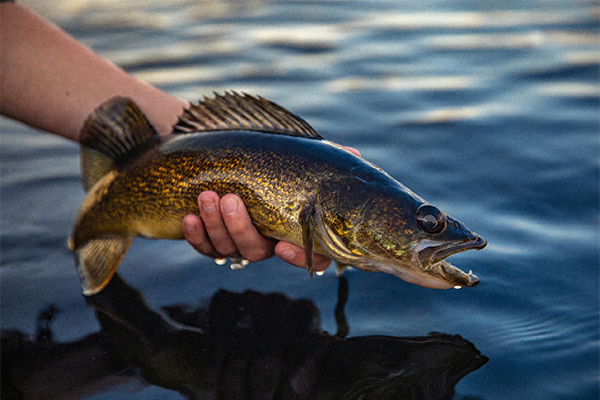
Walleye Fishing at Kitchi Island Outposts
“The walleye is the most valuable and intensively utilized fishery resource in Manitoba. Walleye angling likely accounts for more time and money spent in Manitoba by both resident and non-resident anglers than all other species combined.”
— The Freshwater Fishes of Manitoba, Stewart & Watkinson
Walleye are one of the five apex predator species in Manitoba’s freshwater ecosystems. In Canadian Shield lakes, including the waters around Kitchi Island Outposts, they share the top of the food chain with northern pike and channel catfish.
Walleye and their close relatives, the sauger, spawn early in the season — typically from late April to late May — just after ice breakup, when water temperatures reach around 4°C (39°F). After spawning, females and often the larger fish rest before resuming feeding and preparing for the next reproductive cycle.
As the water warms, walleye school, eventually spreading throughout the lakes and river systems around Kitchi Island Outposts. They occupy diverse habitats, including weed beds, fast-moving water, and areas with structure.
The region offers a variety of fishing habitats. The land drops roughly 200 feet from the Ontario border to the shore of Lake Winnipeg (about 2 feet per mile), creating a rich mix of environments. Anglers will find expansive lake areas, fast-flowing rivers, quiet bays with deep weed beds, and ambush spots with rocks and current.
Fishing Techniques
Walleye tactics are diverse. Popular methods include:
- Jigging with a twister tail, often tipped with a frozen minnow or Berkley Gulp bait
- Leeches or night crawlers for natural bait
- Trolling or bottom bouncing with minnow spinners, Gulp, or deep-trolled Rapala-type crankbaits
- Casting crankbaits or spoons into fast water areas
Whatever method you choose, walleye in Kitchi waters range from small fish to over 30 inches. Many “Master Angler” walleye (over 28 inches) are caught and released each year. The average catch is between 16–23 inches, with some guests reporting over 100 walleye in a single day.
Appearance
The stained waters of the Berens River system produce walleye with deep green, almost black backs, golden sides, and cream-colored undersides. Caudal and anal fins often have orange tips. Walleye lack scales on their cheeks, unlike their sauger cousins, which are brown-grey with 2–3 irregular blotches.
Hybrids appear occasionally, usually yellowish with dorsal fin spots. Anglers prize both species equally for eating quality.
Catch & Release Policy
Kitchi Island Outposts practices and encourages catch-and-release:
- All walleye over 18 inches should be returned unharmed
- Only smaller fish should be used for shore lunch or dinner
- Manitoba law requires barbless hooks; barbs must be pinched down
- Anglers are encouraged to cut one arm of each treble hook to protect the fish
These measures ensure walleye are returned safely, maintaining a thriving fishery for future generations.